
Kia Soul (SK3): Interior features / Seat warmer
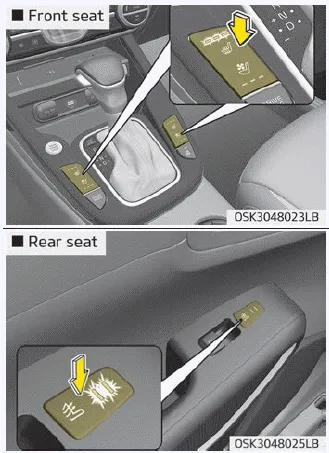
The seat warmer is provided to warm the front seats during cold weather. With the ignition switch in the ON position, push either of the switches to warm the driver's seat or the front passenger's seat.
During mild weather or under conditions where the operation of the seat warmer is not needed, keep the switches in the "OFF" position.
Temperature control (Manual)
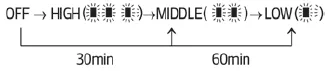
• Each time you press the switch, the temperature setting of the seat will change as follows :

• The seat warmer defaults to the OFF position whenever the ignition switch is turned on.
Temperature control (Automatic)
The seat warmer starts to automatically control the seat temperature in order to prevent low-temperature burns after being manually turned ON.
You may manually press the button to increase the seat temperature. However, it soon returns to the automatic mode again.
- When pressing the switch for more than 1.5 seconds with the seat warmer operating, the seat warmer will turn OFF.
- The seat warmer defaults to the OFF position whenever the Engine Start/ Stop button is in the ON position.
NOTICE
With the seat warmer switch in the ON position, the heating system in the seat turns off or on automatically depending on the seat temperature.
CAUTION
- When cleaning the seats, do not use an organic solvent such as paint thinner, benzene, alcohol and gasoline. Doing so may damage the surface of the heater or seats.
- To prevent overheating the seat warmer, do not place anything on the seats that insulates against heat, such as blankets, cushions or seat covers while the seat warmer is in operation.
- Do not place heavy or sharp objects on seats equipped with seat warmers. Damage to the seat warming components could occur.
- Do not change the seat cover. It may damage the seat warmer or airventilation system.
WARNING
Seat warmer burns
Passengers should use extreme caution when using seat warmers due to the possibility of excess heating cause burns even at low temperatures, especially if used for long periods of time. In particular, the driver must exercise extreme care for the following types of passengers:
1. Infants, children, elderly or handicapped persons, or hospital outpatients
2. Persons with sensitive skin or those that burn easily
3. Fatigued individuals
4. Intoxicated individuals
5. Individuals taking medication that can cause drowsiness or sleepiness (sleeping
pills, cold tablets, etc.)
Use the sunvisor to shield direct light through the front or side windows. To use the sunvisor, pull it downward. To use the sunvisor for the side window, pull it downward, unsnap it from the bracket (1) and swing it to the side (2).
The temperature setting of the seat changes according to the switch position. • If you want to warm your seat cushion, press the switch (red color).
Other information:
Kia Soul (SK3) 2020-2025 Owners Manual: Removing and storing the spare tire
Turn the tire hold-down wing bolt counterclockwise to remove. Store the tire in the reverse order of removal. To prevent the spare tire and tools from “rattling” while the vehicle is in motion, store them properly. WARNING Ensure the spare tire retainer is properly aligned with the center of the spare tire to prevent the spare tire f
Kia Soul (SK3) 2020-2025 Owners Manual: Distributing the sealant
11. Immediately drive approximately 7~10 km (4~6 miles or, about 10min) to evenly distribute the sealant in the tire. CAUTION Do not exceed a speed of 80 km/h (50 mph). If possible, do not fall below a speed of 20 km/h (12 mph). While driving, if you experience any unusual vibration, ride disturbance or noise, reduce your speed and drive wi
Categories
- Manuals Home
- Kia Soul Owners Manual
- Defogging logic
- Immobilizer system
- Check tire pressure
- New on site
- Most important about car
