
Kia Soul (SK3): If you have a flat tire (with Tire Mobility Kit) / Introduction
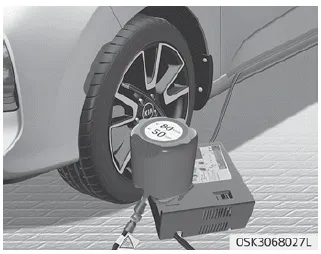
With the Tire Mobility Kit (TMK) you stay mobile even after experiencing a tire puncture.
The system of compressor and sealing compound effectively and comfortably seals most punctures in a passenger car tire caused by nails or similar objects and reinflates the tire.
After you ensured that the tire is properly sealed you can drive cautiously on the tire (up to 200 km (120 miles)) at a max. speed of 80 km/h (50 mph) in order to reach a vehicle or tire dealer to have the tire replaced.
It is possible that some tires, especially with larger punctures or damage to the sidewall, cannot be sealed completely. Air pressure loss in the tire may adversely affect tire performance.
For this reason, you should avoid abrupt steering or other driving maneuvers, especially if the vehicle is heavily loaded or if a trailer is in use. The TMK is not designed or intended as a permanent tire repair method and is to be used for one tire only.
This instruction shows you step by step how to temporarily seal the puncture simply and reliably.
Read “Notes on the safe use of the Tire Mobility Kit” on page 7-26.
WARNING
Do not use the TMK if a tire is severely damaged by driving run flat or with insufficient air pressure. Only punctured areas located within the tread region of the tire can be sealed using the TMK.
Please read the instructions before using the Tire Mobility Kit. 1. Sealant bottle 2. Compressor The Tire Mobility Kit is a temporary fix to the tire and we recommend that the tire inspected by an authorized Kia dealer as soon as possible.
1. Speed restriction label 2. Sealant bottle and label with speed restriction 3. Filling hose from sealant bottle to wheel 4. Connectors and cable for the battery direct connection 5.
Other information:
Kia Soul (SK3) 2020-2025 Owners Manual: Removing and storing the spare tire
Turn the tire hold-down wing bolt counterclockwise to remove. Store the tire in the reverse order of removal. To prevent the spare tire and tools from “rattling” while the vehicle is in motion, store them properly. WARNING Ensure the spare tire retainer is properly aligned with the center of the spare tire to prevent the spare tire f
Kia Soul (SK3) 2020-2025 Owners Manual: Battery
For best battery service Keep the battery securely mounted. Keep the battery top clean and dry. Keep the terminals and connections clean, tight, and coated with petroleum jelly or terminal grease. Rinse any spilled electrolyte from the battery immediately with a solution of water and baking soda.
Categories
- Manuals Home
- Kia Soul Owners Manual
- Features of your vehicle
- Changing tires
- Mirrors. Outside rearview mirror. Folding the outside rearview mirror
- New on site
- Most important about car
