
Kia Soul (SK3): Air bag - supplemental restraint system / Curtain air bag
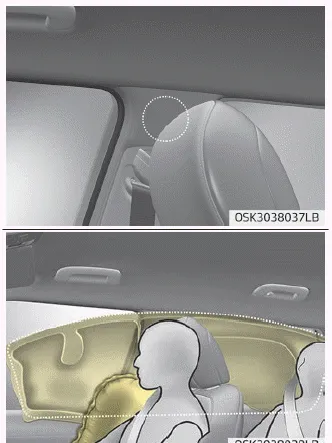
❈ The actual air bags in the vehicle may differ from the illustration. Curtain air bags are located along both sides of the roof rails above the front and rear doors.
They are designed to help protect the heads of the front seat occupants and the rear outboard seat occupants in certain side impact collisions.
The curtain air bags are designed to deploy during certain side impact collisions, depending on the crash severity, angle, speed and point of impact. The curtain air bags are not designed to deploy in all side impact situations, collisions from the front or rear of the vehicle or in most rollover situations.
WARNING
- Do not hang heavy items on the coat hooks for safety reasons.
- In order for side and curtain air bags to provide the best protection, both front seat occupants and both outboard rear occupants should sit in an upright position with the seat belts properly fastened. Importantly, children should sit in a proper child restraint system in the rear seat.
- When children are seated in the rear outboard seats, they must be seated in the proper child restraint system. Make sure to put the child restraint system as far away from the door side as possible, and secure the child restraint system in a locked position.
- Do not allow the passengers to lean their heads or bodies onto doors, put their arms on the doors, stretch their arms out of the window, or place objects between the doors and passengers when they are seated on seats equipped with side and/or curtain air bags.
- Never try to open or repair any components of the curtain air bag system. If necessary, have the system serviced by a professional workshop. Kia recommends to visit an authorized Kia dealer/service partner.
Failure to follow the above mentioned instructions can result in injury or death to the vehicle occupants in an accident.
WARNING
No attaching objects
• Do not place any objects over the air bag. Also, do not attach any objects around the area the air bag inflates such as the door, side door glass, front and rear pillar, roof side rail.
• Do not hang hard or breakable objects on the clothes hanger.
❈ The actual air bags in the vehicle may differ from the illustration. Your vehicle is equipped with a side air bag in each front seat. The purpose of the air bag is to provide the vehicle's driver and/or the front passenger with additional protection than that offered by the seat belt alone.
There are many types of accidents in which the air bag would not be expected to provide additional protection. These include rear impacts, second or third collisions in multiple impact accidents, as well as low speed impacts.
Other information:
Kia Soul (SK3) 2020-2025 Owners Manual: If you have a flat tire (with spare tire)
Jack and tools The jack, jack handle, wheel lug nut wrench are stored in the luggage compartment. Pull up the luggage box cover to reach this equipment. 1. Jack handle 2. Jack 3. Wheel lug nut wrench Jacking instructions The jack is provided for emergency tire changing only.
Kia Soul (SK3) 2020-2025 Owners Manual: Checking the tire inflation pressure
1. After driving approximately 7~10 km ( 4~6 miles or about 10 minutes), stop at a suitable location. 2. Connect connection hose (10) of the compressor directly to the tire valve. 3. Connect between compressor and the vehicle power outlet using the cable and connectors.
Categories
- Manuals Home
- Kia Soul Owners Manual
- Defogging logic
- Safety features of your vehicle
- LCD display modes. User settings mode
- New on site
- Most important about car
