
Kia Soul (SK3): Air bag - supplemental restraint system / Driver's and passenger's front air bag. Passenger’s front air bag ON/OFF switch
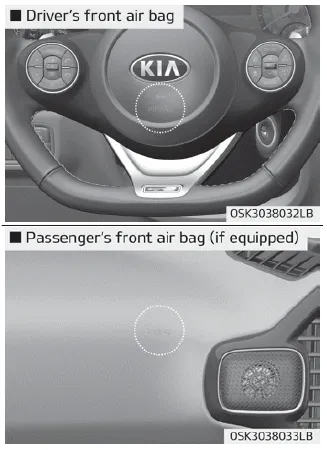
Your vehicle is equipped with a Supplemental Restraint (Air Bag) System and lap/shoulder belts at both the driver and passenger seating positions.
The indications of the system's presence are the letters "AIR BAG" intagliated on the air bag pad cover in the steering wheel and the passenger's side front panel pad above the glove box.
The SRS consists of air bags installed under the pad covers in the center of the steering wheel and the passenger's side front panel above the glove box. The purpose of the SRS is to provide the vehicle's driver and/or the front passenger with additional protection than that offered by the seat belt system alone in case of a frontal impact of sufficient severity.
WARNING
The driver's hands should be placed on the steering wheel at the 9:00 and 3:00 positions. The passenger's arms and hands should be placed on their laps.
WARNING
Always use seat belts and child restraints – every trip, every time, everyone! Air bags inflate with considerable force and in the blink of an eye. Seat belts help keep occupants in proper position to obtain maximum benefit from the air bag. Even with air bags, improperly and unbelted occupants can be severely injured when the air bag inflates. Always follow the precautions about seat belts, air bags and occupant safety contained in this manual. To reduce the chance of serious or fatal injuries and receive the maximum safety benefit from your restraint system:
- Never place a child in any child or booster seat in the front seat.
- ABC – Always Buckle Children in the back seat. It is the safest place for children of any age to ride.
- Front and side air bags can injure occupants improperly positioned in the front seats.
- Move your seat as far back as practical from the front air bags, while still maintaining control of the vehicle.
- You and your passengers should never sit or lean unnecessarily close to the air bags. Improperly positioned drivers and passengers can be severely injured by inflating air bags.
- Never lean against the door or center console – always sit in an upright position.
- No objects should be placed over or near the air bag modules on the steering wheel, instrument panel, and the front passenger's panel above the glove box, because any such object could cause harm if the vehicle is in a crash severe enough to cause the air bags to deploy.
- Do not tamper with or disconnect SRS wiring or other components of the SRS system. Doing so could result in injury, due to accidental deployment of the air bags or by rendering the SRS inoperative.
- If the SRS air bag warning light remains illuminated while the vehicle is being driven, have the system inspected by a professional workshop. Kia recommends to visit an authorized Kia dealer/service partner.
- Air bags can only be used once – have the system replaced by a professional workshop. Kia recommends to visit an authorized Kia dealer/service partner.
- The SRS is designed to deploy the front air bags only when an impact is sufficiently severe and when the impact angle is less than 30° from the forward longitudinal axis of the vehicle. Additionally, the air bags will only deploy once. Seat belts must be worn at all times.
- Front air bags are not intended to deploy in side-impact, rear-impact or rollover crashes. In addition, front air bags will not deploy in frontal crashes below the deployment threshold.
- A child restraint system must never be placed in the front seat. The infant or child could be severely injured or killed by an air bag deployment in case of an accident.
- Children age 13 and under must always be properly restrained in the rear seat. Never allow children to ride in the front passenger seat. If a child over 13 must be seated in the front seat, he or she must be properly belted and the seat should be moved as far back as possible.
- For maximum safety protection in all types of crashes, all occupants including the driver should always wear their seat belts whether or not an air bag is also provided at their seating position to minimize the risk of severe injury or death in the event of a crash. Do not sit or lean unnecessarily close to the air bag while the vehicle is in motion.
- Sitting improperly or out of position can result in serious or fatal injury in a crash. All occupants should sit upright with the seat back in an upright position, centered on the seat cushion with their seat belt on, legs comfortably extended and their feet on the floor until the vehicle is parked and the ignition key is removed.
- The SRS air bag system must deploy very rapidly to provide protection in a crash. If an occupant is out of position because of not wearing a seat belt, the air bag may forcefully contact the occupant causing serious or fatal injuries.
Passenger’s front air bag ON/OFF switch
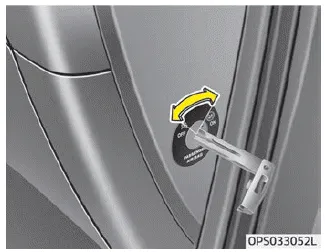
The passenger’s front air bag can be deactivated by the passenger’s front air bag ON/OFF switch if a child restraint is installed on the front passenger's seat or if the front passenger's seat is unoccupied by a person. To ensure the safety of your child, the passenger’s front air bag must be deactivated when it should be necessary to install a rearward facing child seat on the front passenger seat in exceptional circumstances.
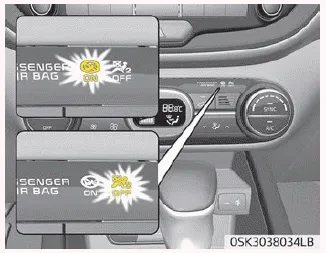
❈ The actual indicator in the vehicle may differ from the illustration.
To deactivate or reactivate the passenger’s front air bag:
To deactivate the passenger’s front air bag, insert the mechanical key into the
passenger’s front air bag ON/OFF switch and turn it to the OFF position. The passenger’s
front air bag OFF indicator ( ) will
illuminate and stay on until the passenger’s front air bag is reactivated.
) will
illuminate and stay on until the passenger’s front air bag is reactivated.
To reactivate the passenger’s front air bag, insert the mechanical key into the
passenger’s front air bag ON/OFF switch and turn it to the ON position. The passenger’s
front air bag OFF indicator will go out and the passenger’s front air bag ON indicator
( ) will illuminate for approximately
60 seconds.
) will illuminate for approximately
60 seconds.
WARNING
On some models, the front air bag ON/OFF switch could turn by using a similar small rigid device. Always check the status of the front air bag ON/OFF switch and passenger's front air bag ON/OFF indicator.
NOTICE
- When the passenger’s front air bag ON/OFF switch is set to the ON position, the passenger’s front air bag is activated and child or infant seat should not be installed on the front passenger seat
- When the passenger’s front air bag ON/OFF switch is set to the OFF position, the passenger’s front air bag is deactivated.
CAUTION
- If the passenger’s front air bag ON/OFF switch is not working properly,
the air bag warning light (
 ) on
the instrument panel will illuminate.
) on
the instrument panel will illuminate.
And, the passenger's front air bag OFF indicator ( )
will not illuminate (The passenger's front air bag ON indicator comes on and
goes off after approximately 60 seconds), the SRS Control Module reactivates
the passenger’s front air bag and the passenger’s front air bag will inflate
in frontal impact crashes even if the passenger’s front air bag ON/OFF switch
is set to the OFF position. In this case, have the system inspected by a professional
workshop. Kia recommends to visit an authorized Kia dealer/service partner.
)
will not illuminate (The passenger's front air bag ON indicator comes on and
goes off after approximately 60 seconds), the SRS Control Module reactivates
the passenger’s front air bag and the passenger’s front air bag will inflate
in frontal impact crashes even if the passenger’s front air bag ON/OFF switch
is set to the OFF position. In this case, have the system inspected by a professional
workshop. Kia recommends to visit an authorized Kia dealer/service partner. - If the SRS air bag warning light blinks or does not illuminate when the ignition switch is turned to the ON position, or if it illuminates while the vehicle is being driven, have the system inspected by a professional workshop. Kia recommends to visit an authorized Kia dealer/service partner.
WARNING
- The driver is responsible for the proper position of the passenger’s front air bag ON/OFF switch.
- Deactivate the passenger's front air bag only when the ignition switch is switched off, or the malfunction may occur in the SRS Control Module. And there may be a danger that the driver's and/or front passenger’s and/or side and curtain air bag may fail to trigger, or not trigger correctly during a collision.
- Never install a rearward facing child seat on the front passenger's seat unless the passenger's front air bag has been deactivated. The infant or child could be severely injured or killed by an air bag deployment in case of an accident. • Even though your vehicle is equipped with the passenger's front air bag ON/OFF switch, do not install a child restraint system in the front passenger's seat. A child restraint system must never be placed in the front seat. Children who are too large for child restraint systems should always occupy the rear seat and use the available lap/ shoulder belts. Children are afforded the most safety in the event of an accident when they are restrained by a proper restraint system in the rear seat.
- As soon as the child seat is no longer needed on the front passenger's seat, reactivate the front passenger's air bag.
- Never place or insert any object into any small opening near side airbag labels attached to the vehicle seats. When the air bag deploys, the object may affect the deployment and result in unexpected accident or bodily harm.
WARNING
No attaching objects
No objects (such as crash pad cover, cellular phone holder, cup holder, perfume or stickers) should be placed over or near the air bag modules on the steering wheel, instrument panel, windshield glass, and the front passenger's panel above the glove box. Such objects could cause harm if the vehicle is in a crash severe enough to cause the air bags to deploy. Do not place any objects over the air bag or between the air bag and yourself.
The SRS consists of the following components: 1. Driver's front air bag module 2. Passenger's front air bag module* 3. Side air bag modules* 4.
❈ The actual air bags in the vehicle may differ from the illustration. Your vehicle is equipped with a side air bag in each front seat. The purpose of the air bag is to provide the vehicle's driver and/or the front passenger with additional protection than that offered by the seat belt alone.
Other information:
Kia Soul (SK3) 2020-2025 Owners Manual: Brake/Clutch fluid. Checking the brake/clutch fluid level
Checking the brake/clutch fluid level Check the fluid level in the reservoir periodically. The fluid level should be between MAX and MIN marks on the side of the reservoir. Before removing the reservoir cap and adding brake/clutch fluid, clean the area around the reservoir cap thoroughly to prevent brake/clutch fluid contamination.
Kia Soul (SK3) 2020-2025 Owners Manual: Emission control system
The emission control system of your vehicle is covered by a written limited warranty. Please see the warranty information contained in the Warranty & Maintenance book in your vehicle. Your vehicle is equipped with an emission control system to meet all emission regulations.
Categories
- Manuals Home
- Kia Soul Owners Manual
- Battery replacement
- Rear seat adjustment
- Specifications & Consumer information
- New on site
- Most important about car
