
Kia Soul (SK3): Driving your vehicle / Key positions. Starting the engine
Ignition switch position
LOCK
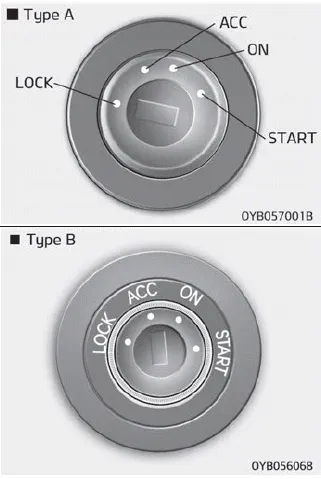
The steering wheel locks to protect against theft. The ignition key can be removed only in the LOCK position.
ACC (Accessory)
The steering wheel is unlocked and electrical accessories are operative.
NOTICE
If difficulty is experienced turning the ignition switch to the ACC position, turn the key while turning the steering wheel right and left to release the tension.
ON
The warning lights can be checked before the engine is started. This is the normal running position after the engine is started.
Do not leave the ignition switch ON if the engine is not running to prevent battery discharge.
START
Turn the ignition switch to the START position to start the engine. The engine will crank until you release the key; then it returns to the ON position. The brake warning light can be checked in this position.
WARNING
Ignition switch
- Never turn the ignition switch to LOCK or ACC while the vehicle is moving.This would result in loss of directional control and braking function, which could cause an accident.
- The anti-theft steering column lock is not a substitute for the parking brake. Before leaving the driver’s seat, always make sure the shift lever is engaged in 1st gear for the manual transaxle, set the parking brake fully and shut the engine off. Unexpected and sudden vehicle movement may occur if these precautions are not taken.
- Never reach for the ignition switch, or any other controls through the steering wheel while the vehicle is in motion. The presence of your hand or arm in this area could cause a loss of vehicle control, an accident and serious bodily injury or death.
- Do not place any movable objects around the driver’s seat as they may move while driving, interfere with the driver and lead to an accident.
Starting the engine
WARNING
- Always wear appropriate shoes when operating your vehicle. Unsuitable shoes (high heels, ski boots, etc.) may interfere with your ability to use the brake, accelerator and clutch pedal (if equipped).
- Do not start the vehicle with the accelerator pedal depressed. The vehicle can move and lead to an accident.
- Wait until the engine rpm is normal. The vehicle may suddenly move if the brake pedal is released when the rpm is high.
Starting the gasoline engine
1. Make sure the parking brake is applied.
2. Manual Transaxle - Depress the clutch pedal fully and shift the transaxle into Neutral. Keep the clutch pedal and brake pedal depressed while turning the ignition switch to the start position. Automatic transaxle / Dual clutch transmission - Place the transaxle shift lever in P (Park). Depress the brake pedal fully.
You can also start the engine when the shift lever is in the N (Neutral) position.
3. Turn the ignition switch to START and hold it there until the engine starts (a maximum of 10 seconds), then release the key. It should be started without depressing the accelerator pedal.
4. Do not wait for the engine to warm up while the vehicle remains stationary. Start driving at moderate engine speeds. (Steep accelerating and decelerating should be avoided.)
Starting and stopping the engine for turbocharger intercooler
1. Do not race or accelerate the engine immediately after starting.
If the engine is cold, idle for several seconds before sufficient lubrication is ensured in the turbocharger unit.
2. After high speed or extended driving, requiring a heavy engine load, idle the engine about 1 minute before turning it off.
This idle time will allow the turbocharger to cool prior to shutting the engine off.
CAUTION
Do not turn the engine off immediately after it has been subjected to a heavy load. Doing so may cause severe damage to the engine or turbocharger unit.
CAUTION
If the engine stalls while you are in motion, do not attempt to move the shift lever to the P (Park) position. If traffic and road conditions permit, you may put the shift lever in the N (Neutral) position while the vehicle is still moving and turn the ignition switch to the START position in an attempt to restart the engine.
CAUTION
- Do not engage the starter for more than 10 seconds. If the engine stalls or fails to start, wait 5 to 10 seconds before re-engaging the starter. Improper use of the starter may damage it.
- Do not turn the ignition switch to the START position with the engine running. It may damage the starter.
Stopping the gasoline engine/ diesel engine (Manual Transaxle)
1. Make sure the vehicle is completely stopped and keep the clutch pedal and brake pedal depressed.
2. Shift the transaxle into Neutral while depressing the clutch pedal and brake pedal.
3. Engage the parking brake while depressing the brake pedal.
4. Turn the ignition key to the LOCK position and remove it.
Before entering vehicle Be sure that all windows, outside mirror(s), and outside lights are clean. Check the condition of the tires. Check under the vehicle for any sign of leaks.
Illuminated engine start/stop button Whenever the front door is opened, the engine start/stop button will illuminate for your convenience. The light will go off after about 30 seconds when the door is closed.
Other information:
Kia Soul (SK3) 2020-2025 Owners Manual: Checking the tire inflation pressure
1. After driving approximately 7~10 km ( 4~6 miles or about 10 minutes), stop at a suitable location. 2. Connect connection hose (10) of the compressor directly to the tire valve. 3. Connect between compressor and the vehicle power outlet using the cable and connectors.
Kia Soul (SK3) 2020-2025 Owners Manual: Scheduled maintenance service
Follow Normal Maintenance Schedule if the vehicle is usually operated where none of the following conditions apply. If any of the following conditions apply, follow Maintenance Under Severe Usage Conditions. Repeated driving short distance of less than 8 km (5 miles) in normal temperature or less than 16 km (10 miles) in freezing tempera
Categories
- Manuals Home
- Kia Soul Owners Manual
- Immobilizer system
- Specifications & Consumer information
- Changing tires
- New on site
- Most important about car
