
Kia Soul (SK3): Lane Keeping Assist (LKA) system / LKA system operation. Warning
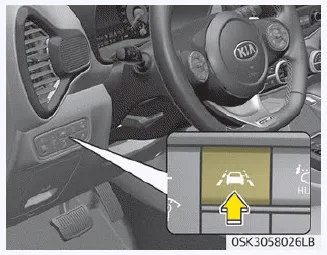
To activate/deactivate LKA:
With the engine start/stop button in the ON position, LKA turns on automatically.
The indicator ( ) in the cluster display
will initially illuminate white. If you press the LKA button located on the instrument
panel on the lower left hand side of the driver, LKA will be turned off and the
indicator on the cluster display will go off.
) in the cluster display
will initially illuminate white. If you press the LKA button located on the instrument
panel on the lower left hand side of the driver, LKA will be turned off and the
indicator on the cluster display will go off.
The color of indicator will change depend on the condition of LKA.
- White : Sensor does not detect the lane marker or vehicle speed is less than
60 km/h (37 mph).
- Green : Sensor detects the lane marker or road edge and system is able to control
the steering.
LKA system activation
- To see LKA system screen on the LCD display in the cluster, Tab to the ASSIST mode ( ).
- For further details, refer to [menu settings] in chapter 4, [crash pad].
- After LKA system is activated, if the lane marker or road edge are detected, vehicle speed is over 60 km/h (37 mph) and all the activation conditions are satisfied, a green steering wheel indicator will illuminate and the steering wheel will be controlled.
WARNING
Lane Keeping Assist System is a system to help prevent the driver from leaving the lane or road edge. However, the driver should not solely rely on the system but always check the road conditions when driving.
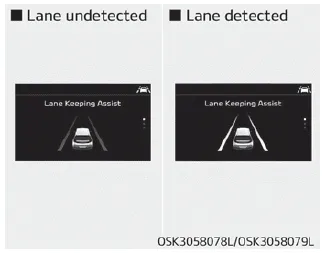
If the speed of the vehicle is over 60 km/h (37 mph) and the system detects lane markers, the color changes from gray to white.
Warning
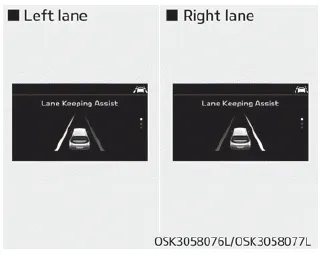
If the vehicle leaves a lane or road edge, the lane marker or road edge you cross will blink on the LCD display and the warning sound is provided.

If the driver takes hands off the steering wheel for several seconds while LKA is activated, the system will warn the driver.
WARNING
- The warning message may appear late according to road conditions. Therefore, always have your hands on the steering wheel while driving.
- If you hold the steering wheel lightly, the system would generate hands off warning because LKA system can treat the situation as you do not grab the wheel.
- If continuous hands-off occurs continuously, the beeping can be lengthened and continued even if LKA steer control is released.
WARNING
- The driver is responsible for accurate steering.
- Even though the steering is assisted by the system, the driver may control the steering wheel.
- Turn off the system and drive the vehicle in below situations.
- In bad weather.
- In bad road condition.
- When the steering wheel needs to be controlled by the driver frequently.
- When towing a vehicle or trailer. - The steering wheel may feel heavier when the steering wheel is assisted by the system than when it is not.
The system will be canceled when:
- You change lanes with the turn signal.
- Using the turn signal to change lanes.
- If you change lanes without the turn signal on, the steering wheel might be controlled. - LKA system can transit to steering assist mode when the car is near to middle of the lane after system on or the lane was changed. LKA system can not assist steering if the vehicle follows lane marker too close continuously before transition to steering assist mode.
- The control of ESC (Electronic Stability Control) or VSM (Vehicle Stability Management) is activated.
- The steering will not be assisted when your drive fast on a sharp curve.
- The steering will not be assisted when vehicle speed is below 55 km/h (34 mph) and over 200 km/h (125 mph).
- The steering will not be assisted when you change lanes or road edge fast.
- The steering will not be assisted when you brake suddenly.
- The steering will not be assisted when the lane is very wide or narrow.
- There are more than two lane markers such as a construction area.
- Radius of a curve is too small.
- When you turn steering wheel suddenly, the LKA system will be disabled temporarily.
- Driving on a steep slope or hill.
Lane Keeping Assist (LKA) system detects the lane markers and road edge on the road with a front view camera at the front windshield, and assists the driver’s steering to help keep the vehicle in the lanes.
The driver must be cautious in the below situations may not work properly when recognition of the lane marker is poor or limited : When lane and road condition is poor It is difficult to distinguish the lane marker or road edge from road when the lane marker or road edge is covered with dust or sand.
Other information:
Kia Soul (SK3) 2020-2025 Owners Manual: Vehicle weight
This section will guide you in the proper loading of your vehicle, to keep your loaded vehicle weight within its design rating capability. Properly loading your vehicle will provide maximum return of the vehicle design performance. Before loading your vehicle, familiarize yourself with the following terms for determining your vehicle's
Kia Soul (SK3) 2020-2025 Owners Manual: Jack label
❈ The actual Jack label in the vehicle may differ from the illustration. For more detailed specifications, refer to the label attached to the jack. 1. Model Name 2. Maximum allowable load 3. When using the jack, set your parking brake. 4. When using the jack, stop the engine.
Categories
- Manuals Home
- Kia Soul Owners Manual
- Check tire pressure
- What to do in an emergency
- Mirrors. Outside rearview mirror. Folding the outside rearview mirror
- New on site
- Most important about car
