
Kia Soul (SK3): Manual heating and air conditioning / Mode selection
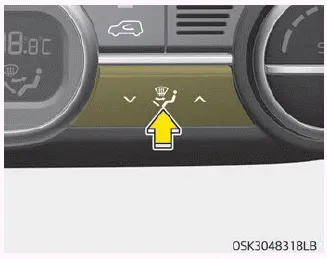
The mode selection button controls the direction of the air flow through the ventilation system.
The air flow outlet port is converted as follows:

Refer to the illustration in the “Manual climate control system” on page 4-112.
Floor & Defrost (A, C, D, E, F)

Most of the air flow is directed to the floor and the windshield with a small amount directed to the side window defrosters.
Face-Level (B, D, F)

Air flow is directed toward the upper body and face. Additionally, each outlet can be controlled to direct the air discharged from the outlet.
Bi-Level (B, D, C, E, F)

Air flow is directed towards the face and the floor.
Floor-Level (C, A, D, E, F)

Most of the air flow is directed to the floor, with a small amount of the air being directed to the windshield and side window defrosters.
Defrost mode
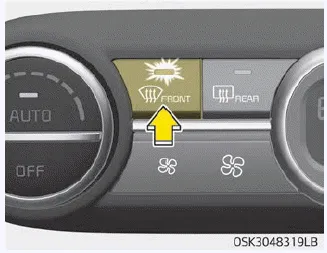
When you select the defrost mode, the following system settings will be made automatically:
- The air conditioning system will be turned on.
- The outside(fresh) air position will be selected.
- The fan speed will be set to the high speed.
To turn the defrost mode off, press the mode button or defrost button again or AUTO button.
Instrument panel vents
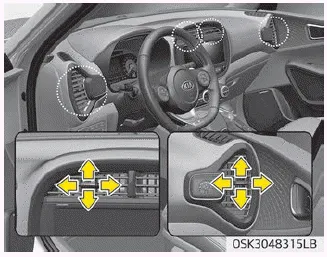
The outlet port can be opened or closed separately using the horizontal thumbwheel. To close the vent, rotate it downward to the maximum position. To open the vent, rotate it upward to the desired position.
Also, you can adjust the direction of air delivered from these vents using the vent control lever as shown.
The heating and cooling system can be controlled manually by pushing buttons other than the AUTO button. In this case, the system works sequentially according to the order of buttons selected.
The temperature will increase to the maximum (HI) by turning the knob to the right extremely. The temperature will decrease to the minimum (Lo) by turning the knob to the left extremely.
Other information:
Kia Soul (SK3) 2020-2025 Owners Manual: Headlamp (LED type) replacement (Headlamp Type C)
If the Low/High beam lamp, Day time running lamp/Position lamp (1) does not operate, have your vehicle checked by a professional workshop. Kia recommends to visit an authorized Kia dealer/service partner. The LED lamps cannot be replaced as a single unit because it is an integrated unit.
Kia Soul (SK3) 2020-2025 Owners Manual: Side repeater lamp (LED type) bulb replacement
If the side repeater lamp (LED), does not operate, have your vehicle checked by a professional workshop. Kia recommends to visit an authorized Kia dealer/service partner. The LED lamps cannot be replaced as a single unit because it is an integrated unit.
Categories
- Manuals Home
- Kia Soul Owners Manual
- Instrument cluster
- Drive mode integrated control system
- System setting and activation
- New on site
- Most important about car
