
Kia Soul (SK3): Limitations of the system / Vehicle recognition
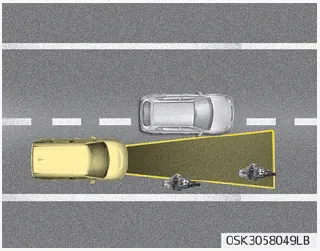
Some vehicles ahead in your lane cannot be recognized by the sensor as follows:
- Narrow vehicles such as motorcycles or bicycles
- Vehicles offset to one side
- Slow-moving vehicles or sudden-decelerating vehicles
- Stopped vehicles
- Vehicles with small rear profile such as trailers with no loads
A vehicle ahead cannot be recognized correctly by the sensor if any of following occurs:
- When the vehicle is pointing upwards due to overloading in the trunk(tailgate)
- While making turns by steering
- When driving to one side of the lane
- When driving on narrow lanes or on curves
Adjust your vehicle speed by depressing the brake pedal according to the road condition ahead and driving condition.
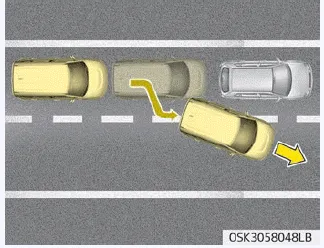
• When vehicles are at a standstill and the vehicle in front of you changes to the next lane, be careful when your vehicle starts to move because it may not recognize the stopped vehicle in front of you.
In this case, you must maintain a safe braking distance, and if necessary, depress the brake pedal to reduce your driving speed in order to maintain a safe distance.
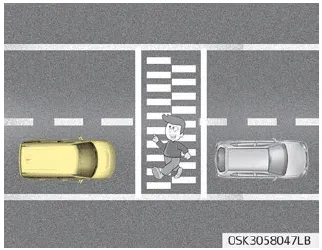
• Always look out for pedestrians when your vehicle is maintaining a distance with the vehicle ahead.
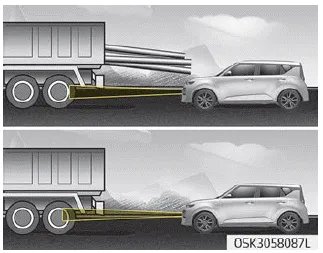
• Always be cautious for vehicles with higher height or vehicles carrying loads that sticks out to the back of the vehicle.
WARNING
- Smart Cruise Control system cannot guarantee the stop for every emergency situation. If an emergency stop is necessary, you must apply the brakes.
- Keep a safe distance according to road conditions and vehicle speed. If the vehicle to vehicle distance is too close during a high-speed driving, a serious collision may result.
- Smart Cruise Control system cannot recognize a stopped vehicle, pedestrians or an oncoming vehicle. Always look ahead cautiously to prevent unexpected and sudden situations from occurring.
- SCC system may have difficulty in maintaining the correct distance or speed, if the vehicle is driving on a steep incline or towing a trailer.
- When other vehicles are changing lanes in front of you frequently, Smart Cruise Control system may not operate appropriately. Always look ahead cautiously to prevent unexpected and sudden situations from occurring.
- Smart Cruise Control system is not a substitute for safe driving practices but a convenience function only. It is the responsibility of the driver to always check the speed and the distance to the vehicle ahead.
- Always be aware of the selected speed and vehicle to vehicle distance.
- Always maintain sufficient braking distance and decelerate your vehicle by applying the brakes if necessary.
- As Smart Cruise Control system may not recognize complex driving situations, always pay attention to driving conditions and control your vehicle speed.
- For safe operation, carefully read and follow the instructions in this manual before use.
- After a vehicle start, please stop for several seconds. If system initialization is not completed, SCC does not normally operate.
- After a vehicle start, if any objects are not detected or the sensor cover is obscured with foreign substances, there is a possibility that SCC system may not work.
- Below conditions are not allowed: over baggage loading in a trunk(tailgate), suspension remodeling, tire replacement with unauthorized tires or tires with different worn-out and pressure levels.
- Do not use Smart Cruise Control system when towing a trailer.
CAUTION
Smart Cruise Control system may not operate temporarily due to electrical interference.
A vehicle which moves into your lane from an adjacent lane cannot be recognized by the sensor until it is in the sensor's detection range. The sensor may not detect immediately when a vehicle cuts in suddenly.
Lane Keeping Assist (LKA) system detects the lane markers and road edge on the road with a front view camera at the front windshield, and assists the driver’s steering to help keep the vehicle in the lanes.
Other information:
Kia Soul (SK3) 2020-2025 Owners Manual: Engine oil (Gasoline)
Checking the engine oil level 1. Be sure the vehicle is on level ground. 2. Start the engine and allow it to reach normal operating temperature. WARNING Radiator hose Be very careful not to touch the radiator hose when checking or adding the engine oil as it may be hot enough to burn you.
Kia Soul (SK3) 2020-2025 Owners Manual: Light bulb position (Rear)
1. Tail lamp (Bulb type) 2. Tail and stop lamp (Bulb type) 3. Rear turn signal lamp (Bulb type) 4. Back-up lamp (Bulb type) 5. Tail lamp (LED type) 6. Stop lamp (LED type) 7. License plate lamp (Bulb type) 8. High mounted stop lamp (Bulb or LED type) 9.
Categories
- Manuals Home
- Kia Soul Owners Manual
- Drive mode integrated control system
- Driving your vehicle
- Maintenance
- New on site
- Most important about car
