
Kia Soul (SK3): Tires and wheels / Tire rotation
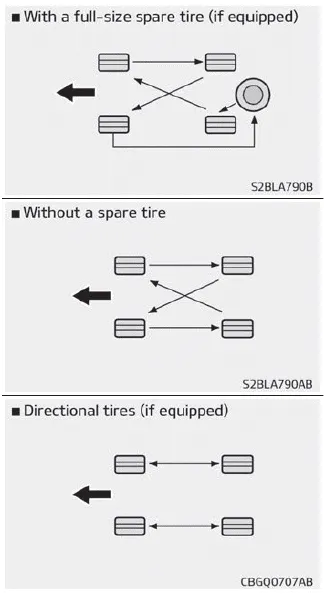
To equalize tread wear, it is recommended that the tires be rotated every 10,000 km (6,500 miles) or 12 months. If irregular wear develops, more frequent tire rotation may be needed.
During rotation, check the tires for correct balance.
When rotating tires, check for uneven wear and damage. Abnormal wear is usually caused by incorrect tire pressure, improper wheel alignment, outof- balance wheels, severe braking or severe cornering. Look for bumps or bulges in the tread or side of tire. Replace the tire if you find either of these conditions. Replace the tire if fabric or cord is visible. After rotation, be sure to bring the front and rear tire pressures to specification and check lug nut tightness.
Refer to “Tire and wheels” on page 9-09.
Disc brake pads should be inspected for wear whenever tires are rotated.
NOTICE
Rotate radial tires that have an directional tread pattern only from front to rear and not from right to left.
WARNING
- Do not use the compact spare tire for tire rotation.
- Do not mix bias ply and radial ply tires under any circumstances. This may cause unusual handling characteristics that could result in death, severe injury, or property damage.
Check your tires once a month or more. Also, check the tire pressure of the spare tire. How to check Use a good quality gauge to check tire pressure.
The wheels on your vehicle were aligned and balanced carefully at the factory to give you the longest tire life and best overall performance. In most cases, you will not need to have your wheels aligned again.
Other information:
Kia Soul (SK3) 2020-2025 Owners Manual: Road warning
Hazard warning flasher The hazard warning flasher serves as a warning to other drivers to exercise extreme caution when approaching, overtaking, or passing your vehicle. It should be used whenever emergency repairs are being made or when the vehicle is stopped near the edge of a roadway.
Kia Soul (SK3) 2020-2025 Owners Manual: Room lamp (Bulb type) bulb replacement
WARNING Prior to working on the Interior lamps, ensure that the “OFF” button is depressed to avoid burning your fingers or receiving an electric shock. 1. Using a flat-blade screwdriver, gently pry the lens cover from lamp housing. 2. Remove the bulb by pulling it straight out.
Categories
- Manuals Home
- Kia Soul Owners Manual
- Defogging logic
- Immobilizer system
- Trip information (trip computer)
- New on site
- Most important about car
